Is Innovation Winter Finally Over?

Plug and Play's November Summit in Sunnyvale last week was packed – and my co-author Paul Campbell and I had some very interesting conversations.
Combined with two months of research interviews with corporate innovation colleagues about AI, a few interesting themes are beginning to emerge.
Here are my five takeaways:
1. The Innovation Winter may finally be thawing.
The corporate innovation bloodletting of the past few years appears to be slowing. As I mentioned in a previous blog post, many of the past budget cuts made room for a new corporate priority: AI Centers of Excellence, typically housed within IT.
But there's a growing realization that AI expertise and innovation capabilities are not interchangeable. Companies need both to succeed. The AI Center of Excellence isn't going away, though- these two groups will need to coexist and collaborate.
2. Corporate AI is still largely about efficiency.
Most corporate AI initiatives we're hearing about focus on eliminating drudgery, automating routine tasks, and improving productivity. There is nothing wrong with that – there’s enormous value that can be captured.
But improving how a company operates is not the same as reimagining what business it should be in. That’s really the more interesting part (more on that below).

3. Those AI Centers of Excellence are doing a lot of internal development and that could spell trouble for some startups.
AI is increasingly viewed as strategic, particularly when it involves proprietary corporate data. Rather than licensing specialized solutions from vertical AI startups, IT organizations are choosing to work directly with foundation model providers such as OpenAI and Anthropic, building their own applications and capabilities on top.
The thinking? Combine powerful general-purpose AI with proprietary corporate data and workflows to create a new competitive moat. This could be bad news for vertical AI startups that specialize in solving one particular business problem.
4. Corporate innovation can build its own AI niche
Building enterprise-wide AI capabilities takes time. Lots of it. And as anyone who's lived through a major IT initiative knows, these projects can become all-consuming.
Meanwhile, AI is opening the door to entirely new products, services, and business models. Who is looking over the horizon while IT is focused on implementation?
This is where corporate innovation teams can shine. Anticipating emerging trends, exploring new business models, and running rapid experiments are exactly what innovation teams are built to do. And Open Innovation—particularly working with external startups—offers a way to test ideas quickly without waiting for that internal AI infrastructure to catch up.
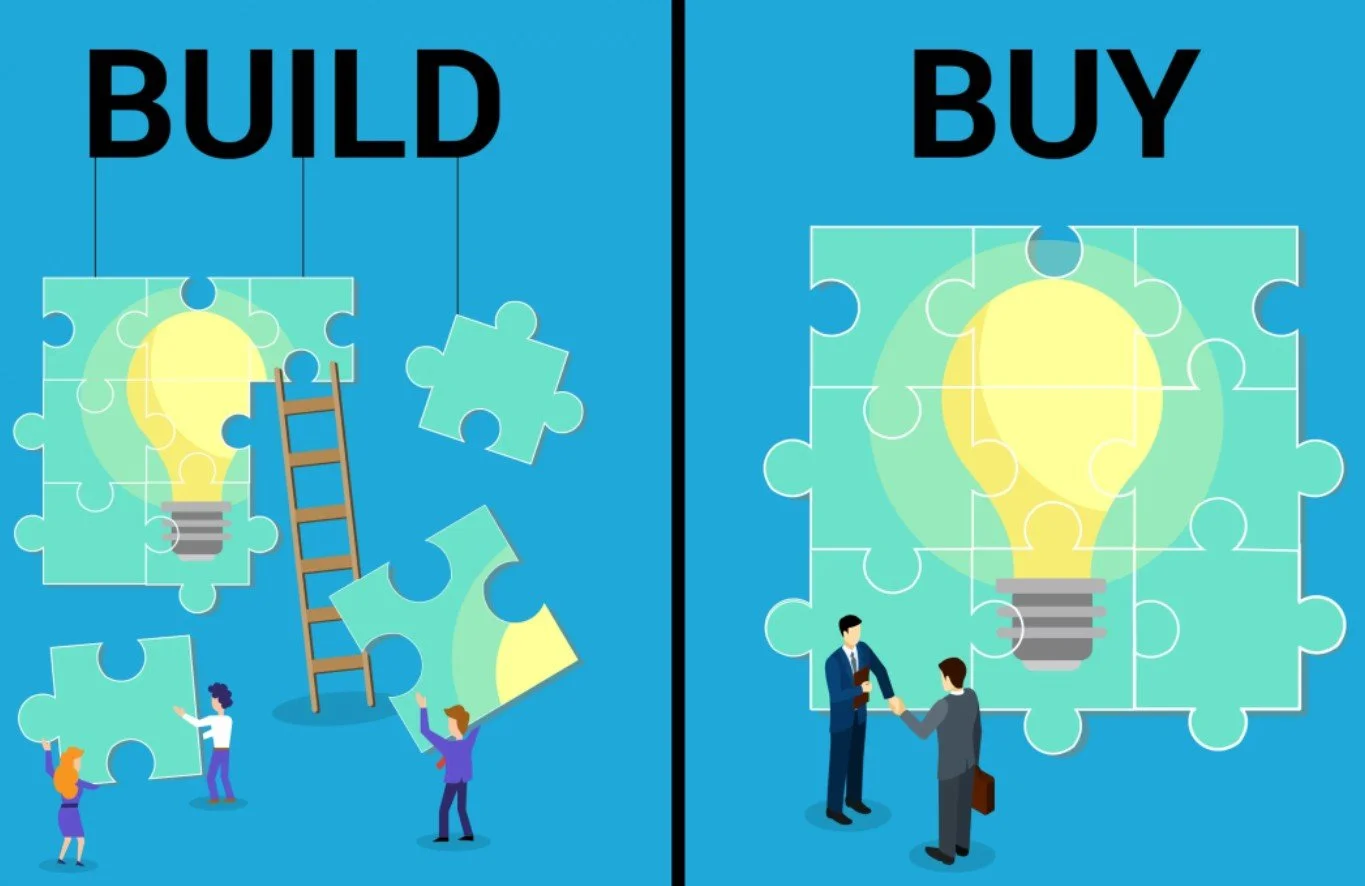
5. Ultimately, we're back to Build vs. Buy.
IT may gravitate toward Build, seeking control, integration, and ownership of proprietary capabilities. Innovation teams may lean toward Buy (or as we prefer to call it, “Partner”) because speed, experimentation, and access to external expertise matter more than owning the technology from day one.
Neither approach is inherently right or wrong. They serve different purposes.
And some of those promising startup partnerships could eventually turn into strategic investments or acquisitions…
Perhaps the real opportunity isn't choosing between Build and Buy, but figuring out how IT and Innovation can pursue both—without getting in each other's way.
Does this resonate with what you're seeing in your organization? Or am I off-base on some of these observations? I'd love to hear your perspective. We're all figuring this out together
mORE ARTICLES IN OUR aRCHIVE:
-
2026
- Nov 17, 2026 Is Innovation Winter Finally Over? Nov 17, 2026
- Mar 31, 2026 Personal Taxes... in the Age of AI Mar 31, 2026
- Jan 15, 2026 CES 2026: The Chinese Electronics Show? Jan 15, 2026
-
2025
- Dec 3, 2025 FOMO and AI Dec 3, 2025
- Sep 15, 2025 Year of the Agent Sep 15, 2025
- Jun 10, 2025 Four Takeaways from Stanford's Annual AI Report Jun 10, 2025
- Mar 28, 2025 Out-Innovated - Part 2 Mar 28, 2025
-
2024
- Dec 17, 2024 Is OpenAI the Next Webvan? Dec 17, 2024
- Oct 4, 2024 What Happened to the Singularity? Oct 4, 2024
- Jun 25, 2024 The VC Void in Germany Jun 25, 2024
-
2023
- Dec 7, 2023 A Big Challenge for AI... And It's Not Technical Dec 7, 2023
- Oct 4, 2023 About That Good Idea... Oct 4, 2023
- Aug 3, 2023 Are we in an Innovation Winter and is ChatGPT to Blame? Aug 3, 2023
- May 26, 2023 How to Build a Growth Factory May 26, 2023
- Mar 22, 2023 ChatGPT and the Pareto Principle Mar 22, 2023
-
2022
- Nov 8, 2022 Disrupted! Nov 8, 2022
-
2021
- Apr 5, 2021 Irrational Exuberance Apr 5, 2021
- Feb 11, 2021 What You (May Have) Missed... Feb 11, 2021
-
2020
- Dec 3, 2020 State of Seed Investor Landscape 2020 Dec 3, 2020
- Aug 7, 2020 Out-Innovated Aug 7, 2020
- Jul 13, 2020 Are Listening Posts Underrated? Jul 13, 2020
- Apr 8, 2020 The State of Innovation in Silicon Valley: 2021 Apr 8, 2020
- Apr 8, 2020 CES & The Emerging Trends of 2020 Apr 8, 2020
- Apr 8, 2020 Our AI Overlords Are Here – And We Feel Fine Apr 8, 2020
-
2019
- Jul 8, 2019 The New Dinosaurs Jul 8, 2019
- May 30, 2019 Peak Silicon Valley? May 30, 2019
-
2018
- Dec 21, 2018 Subscription Hallucination Dec 21, 2018
- Sep 26, 2018 Scooter Madness Sep 26, 2018
- Jun 8, 2018 Is Innovation Best Suited For the Young? Jun 8, 2018
- Apr 16, 2018 Six Years Inside the Automotive Innovation Pipeline: What I Learned Apr 16, 2018
- Jan 4, 2018 So.. You Want to Launch a Consumer Hardware Startup? Jan 4, 2018
-
2017
- Nov 28, 2017 Wearables Meet Air Nov 28, 2017
- Jul 26, 2017 Learning to Sell Jul 26, 2017
- May 3, 2017 Is Virtual Reality Going the Way of 3D TV? May 3, 2017
- Mar 3, 2017 Traction: the Elixir of Life Mar 3, 2017
- Feb 9, 2017 Artificial Intelligence: Back to the Future? Feb 9, 2017
-
2015
- Sep 30, 2015 Silicon Valley Is Not the Solution to Your Problem Sep 30, 2015
- Aug 11, 2015 The Multi-Dimensional Startup Aug 11, 2015
- Feb 6, 2015 Wearables: What's next? Feb 6, 2015
-
2014
- Oct 15, 2014 Startup Burn Rate: Simmer or Meteor? Oct 15, 2014
- Aug 27, 2014 5 Surprises About Internet of Things Aug 27, 2014
- Jun 19, 2014 How to Talk to Corporates Jun 19, 2014
- Apr 30, 2014 How to Talk to Startups Apr 30, 2014
- Mar 11, 2014 Avoid the Corporate Disease Mar 11, 2014
- Feb 11, 2014 The Corporate Disease Feb 11, 2014
- Jan 28, 2014 Founders vs. Owners Jan 28, 2014
- Jan 10, 2014 CES at the Fringe Jan 10, 2014
- Jan 3, 2014 Silicon Valley Lite Jan 3, 2014
-
2013
- Dec 17, 2013 How Corporates are Plugging In Dec 17, 2013
- Dec 10, 2013 Can't We All Get Along? Dec 10, 2013